
Reviewed · DHARAVI SLUM TOURS
Private City Tour with Dharavi Slum Dhobighat and Dabbawalla
Mumbai reveals itself best through contrasts. On this private tour, you move from the Gateway of India and grand colonial buildings to Mahalaxmi Dhobi Ghat and the working lanes of Dharavi. The day gives you a broad look at the city, but its most memorable hours are likely to be the two spent in Dharavi, where daily work and home life share the same small area.
I like the private format, which lets you ask questions, adjust the pace, and request changes. I also like the guide service, especially if you are matched with Siddhi, often called Sid, whose warm, flexible style has earned strong praise. The main consideration is the long schedule: fourteen stops in 6 to 7 hours can mean quick visits and considerable time in Mumbai traffic.
In This Review
- Key points to know before booking
- A full day built around Mumbai’s sharp contrasts
- Gateway of India and the Colaba opening
- Gothic Mumbai at the university and High Court
- CST and Crawford Market
- Marine Drive and the city from above
- Gandhi’s Mumbai at Mani Bhavan
- Banganga and the layers of Malabar Hill
- Antilia and Mumbai’s extreme wealth
- Dhobi Ghat, Mumbai’s famous open-air laundry
- Dharavi, approached with care
- What the private format adds
- Price, pace, and what you receive
- Who should book this Mumbai tour
- Should you book it?
- FAQ
- How long does the Mumbai city tour last?
- What time and where does the tour begin?
- Where does the tour end?
- Is this a private tour?
- How much does the tour cost?
- How much time is spent in Dharavi?
- Can I cancel for a full refund?
Key points to know before booking
- Two hours in Dharavi: The longest stop focuses on homes, workshops, and local industry in one of Mumbai’s most densely settled areas.
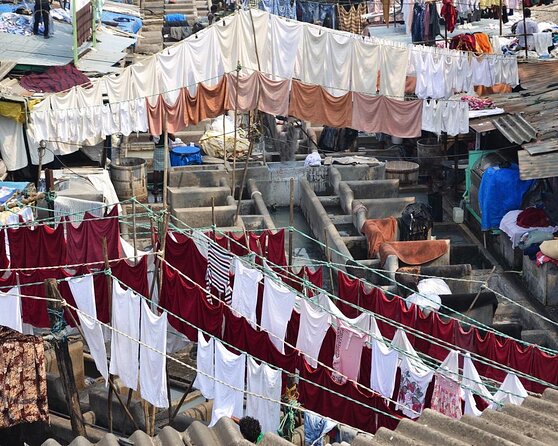
- Dhobi Ghat with context: A 30-minute visit introduces the famous open-air laundry beside Mahalaxmi station.
- Private guide and vehicle service: Only your group participates, with pickup offered and a mobile ticket provided.
- Major Mumbai sights in one day: You see the Gateway of India, CST, Crawford Market, Marine Drive, Mani Bhavan, and more.
- A flexible guide matters: Siddhi, also called Sid, is praised for clear explanations, personal warmth, and willingness to adjust the day.
- Good value for a first visit: At $75.69 per person, the tour packs in a lot, though the number of stops limits time at each one.
A full day built around Mumbai’s sharp contrasts
The tour begins at 9:30 a.m. near Regal Cinema in Apollo Bandar, Colaba. Pickup is offered, so confirm the arrangement when you book rather than assuming you should go directly to the meeting point.
The route covers South Mumbai’s grand civic buildings, religious sites, public spaces, and working neighborhoods. You are not simply checking off monuments. The real value comes from having a guide explain how these places connect: colonial administration, railways, religion, politics, commerce, luxury, and informal industry all appear during the day.
Still, the schedule is ambitious. Most sightseeing stops last only 20 minutes, with 10 minutes at the High Court and 30 minutes at Dhobi Ghat. That is enough for an introduction and photographs, but not for a slow museum visit or a detailed architectural study.
More Dhobi Ghat and dabbawala tours:
- Mumbai: Dharavi Slum, DhobiGhat, and Dabbawallas Tour
★ 4.9 · 689 reviews - Mumbai: Dhobi Ghat Laundry and Dharavi Slum Tour with Local
★ 5.0 · 469 reviews - Mumbai: Dharavi Slum & Dhobi Ghat Laundry Tour
★ 5.0 · 352 reviews
Gateway of India and the Colaba opening
The Gateway of India is the natural opening scene. Built in the early 20th century, the arch commemorates the arrival of King-Emperor George V, the first British monarch to visit India. Its position by the water also connects it to Mumbai’s long role as a port city.
You have about 20 minutes here. That works well for orientation and photographs, though it is not enough to explore the nearby Taj Mahal Palace area or spend much time watching harbor activity. If this is your first morning in Mumbai, the stop quickly gives you a sense of the city’s scale and grand public spaces.
Gothic Mumbai at the university and High Court
The University of Mumbai Library and the Bombay High Court introduce the city’s grand institutional architecture. The university is a public research institution with hundreds of affiliated colleges, while the High Court serves Maharashtra and Goa along with the union territories of Dadra and Nagar Haveli and Daman and Diu.
The tour allows 20 minutes at the library and 10 minutes at the court. Treat these as exterior viewing stops unless your guide tells you otherwise. Their value lies in the setting and explanation, not in a long interior visit.
A private guide can make this short section more useful by pointing out how Mumbai’s colonial-era buildings shaped the city center. Without that context, the stops may feel like a quick succession of impressive facades.
CST and Crawford Market
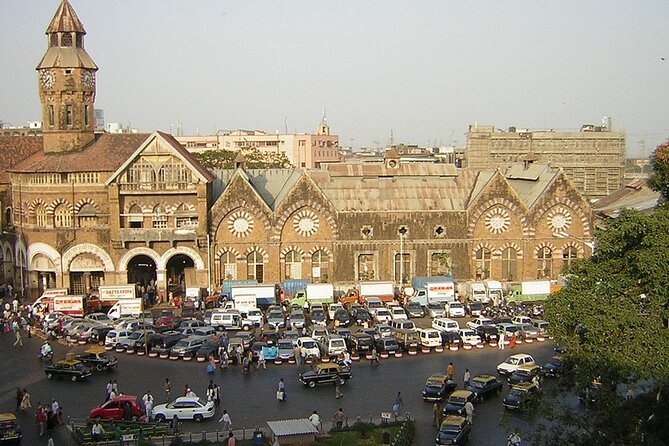
Chhatrapati Shivaji Terminus is one of the day’s strongest architectural stops. The historic railway terminus is a UNESCO World Heritage Site, and its design blends Victorian Gothic ideas with Indian decorative details. You have 20 minutes, enough to appreciate the exterior and watch the constant movement around one of Mumbai’s key rail hubs.
Crawford Market follows with a more commercial view of the city. Completed in 1869 and donated to Mumbai by Cowasji Jehangir, the market remains one of South Mumbai’s best-known trading centers. The 20-minute stop is brief, but it gives you a taste of the city’s buying and selling culture.
I would pay attention to the guide here rather than trying to shop. The short timing makes browsing difficult, and the tour is more useful as a way to understand the market’s role than as a dedicated food or shopping visit.
More Dharavi walking tours:
- Dharavi slum tour in Mumbai by Female tour guides of the slum
★ 5.0 · 1,976 reviews - Dharavi Slum Tour
★ 5.0 · 625 reviews - Dharavi Slum tour in Mumbai by local resident
★ 5.0 · 572 reviews - Mumbai: Dharavi Slum Slumdog Millionaire Tour with a Local
★ 4.9 · 529 reviews
Marine Drive and the city from above
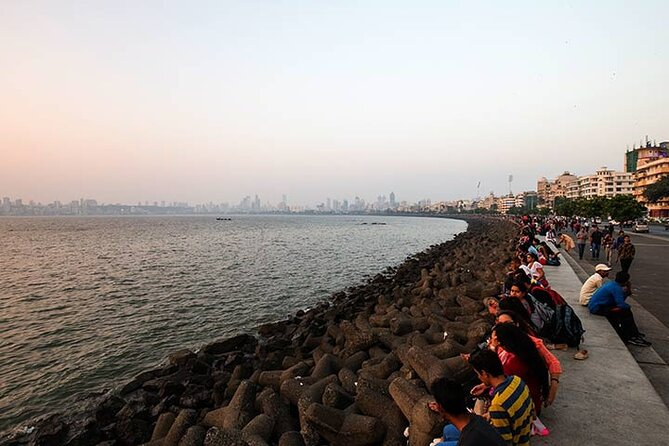
Marine Drive provides a change of pace. The three-kilometer promenade curves along Netaji Subhash Chandra Bose Road, giving you a broad view of Mumbai’s seafront and dense urban core.
The 20-minute stop is best for a walk, photographs, and a quick pause from traffic. You will not have time to stroll the entire promenade. That is fine, since this tour is designed as a city overview rather than a leisurely coastal outing.
The route then climbs toward Malabar Hill. The Hanging Gardens and Kamala Nehru Park each receive about 20 minutes. Both offer views toward Marine Drive, and the elevated position helps you understand how tightly Mumbai’s neighborhoods fit together.
Kamala Nehru Park was built in 1952 and covers 4,000 square yards. The park is named after the wife of Prime Minister Nehru and is especially useful for its outlook over Marine Drive. The Hanging Gardens, also called Pherozeshah Mehta Gardens, sit across from the park.
These stops may feel similar if your schedule is running late. I would ask the guide to explain how they differ and to keep the visit moving. Their main purpose is the view, not a long garden walk.
Gandhi’s Mumbai at Mani Bhavan
Mani Bhavan is one of the more meaningful stops for anyone interested in modern Indian history. The building on Laburnum Road served as a focus of Gandhi’s political work in Mumbai between 1917 and 1934. Today it functions as a museum and historical site dedicated to him.
You have 20 minutes here. That is a short visit for a museum, but enough to see the setting and receive an introduction from your guide. If Gandhi’s life is a major interest, you may want more time than this tour allows.
This is also a useful point to ask questions. A good explanation can connect the building to the wider political changes that shaped India. Siddhi or Sid is particularly well suited to this kind of stop because the guide is described as both clear in explanation and easy to talk with.
Banganga and the layers of Malabar Hill
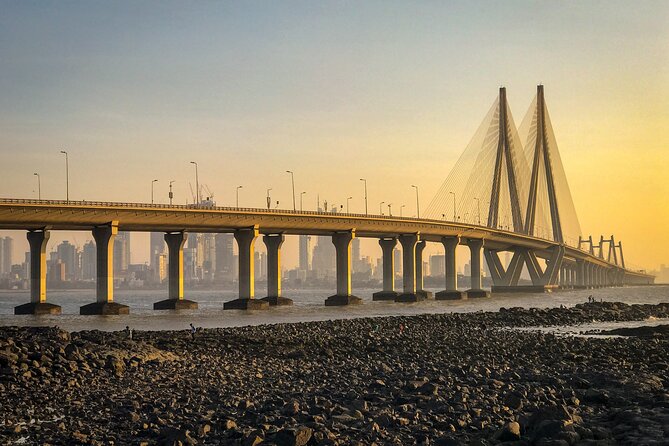
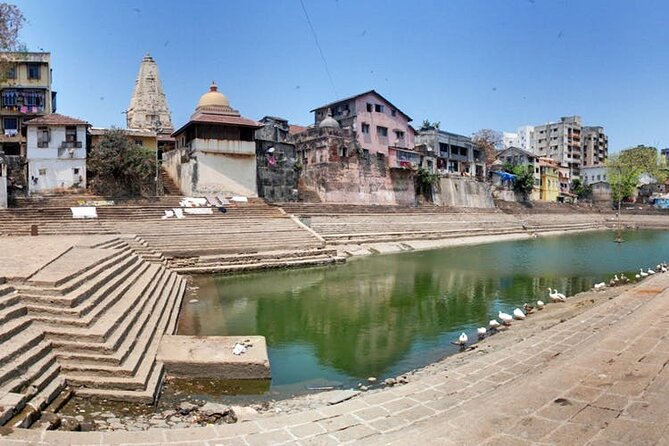
Banganga Tank is part of the Walkeshwar Temple complex on Malabar Hill. It offers a different side of Mumbai from the formal buildings and seafront roads: a sacred water tank within an active religious setting.
The scheduled 20 minutes give you a quick look. Be respectful around worshippers and follow your guide’s advice about where to walk and when photography is suitable. The stop is not a full religious tour, but it adds cultural depth to the Malabar Hill section.
Antilia and Mumbai’s extreme wealth
Antilia is the private residence of billionaire Mukesh Ambani and his family. Located in Mumbai’s billionaire’s row, the house is named after the mythical island Antillia and has been occupied by the family since 2012.
The tour gives you 20 minutes in the area. This is an exterior viewing stop, not a chance to enter the property. Its appeal comes from the striking contrast with the working communities you visit later in the day.
That contrast can feel blunt, but it is also one of the clearest ways to see Mumbai’s economic range. The guide’s commentary matters here. The stop works best as part of a wider conversation about the city, not as a celebrity-home photo opportunity.
Dhobi Ghat, Mumbai’s famous open-air laundry
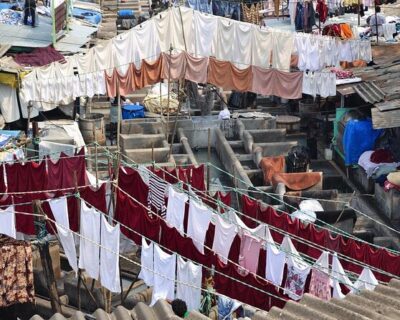
Mahalaxmi Dhobi Ghat is one of the tour’s most distinctive stops. It is an open-air laundry near Mahalaxmi railway station, also reachable from Jacob Circle monorail station. Washers, traditionally known as dhobis, work in a highly organized setting that has become a well-known part of Mumbai’s identity.
You get 30 minutes here, longer than at most city sights. That extra time helps you watch the process and understand how the laundry functions as a working service rather than a staged attraction.
Your guide should help you observe without getting in the way. This is a place where respectful behavior matters. Listen before taking photographs, and follow any instructions about where you may stand.
The stop also prepares you for Dharavi. Both places show how much work happens in spaces that outsiders might wrongly dismiss as chaotic. The key difference is that Dhobi Ghat is a specialized laundry operation, while Dharavi contains homes, workshops, businesses, and community life across a much larger area.
Dharavi, approached with care
The final stop is Dharavi, where the tour ends at Kumbhar Wada. The visit lasts about two hours, making it the heart of the day. Dharavi covers just over 2.1 square kilometers and is home to about one million people, according to the supplied tour information.
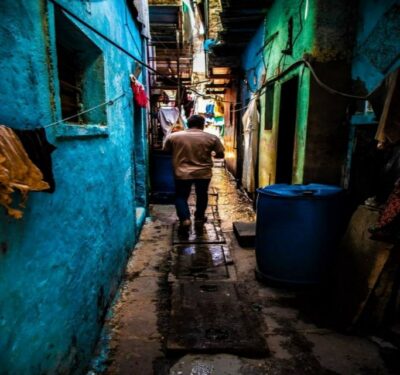
Calling Dharavi only a slum misses much of what you are there to understand. It is also a place of work, production, family life, and small businesses. A private guide can explain these layers while helping you move through the area with more care than you might manage alone.
The experience may include views of private homes and working spaces, so your attitude matters. Avoid treating people’s lives as a spectacle. Ask before photographing, listen to the guide, and remember that the area is a neighborhood first and a sightseeing stop second.
Two hours allows more than a quick look. You can begin to understand how homes and workspaces exist side by side and how local services support the wider city. The value is not in collecting dramatic images. It is in seeing the skill, labor, and organization behind an area that is often reduced to a single label.
The tour title also mentions dabbawallas, Mumbai’s famous lunch-delivery workers. The scheduled stops supplied here do not identify a separate dabbawalla meeting or demonstration. If that part of the experience is important to you, ask Namaste Tours and Trips to confirm exactly how it is covered before booking.
What the private format adds
This is a private activity, so only your group participates. That changes the day in practical ways. You can ask for more explanation at CST, shorten a photo stop, or discuss adding a place you have not yet seen. One guide, Sid, is specifically described as flexible and willing to add new places when the group had already visited some of the planned sights.
Pickup is offered, and the tour ends in Dharavi rather than returning to the Colaba starting point. That ending matters. You should plan your next move from Dharavi and confirm the final drop-off details in advance, especially if you have a train, flight, or hotel reservation.
The experience takes 6 to 7 hours. The private setup is most useful for couples, families, and small groups who want conversation rather than a fixed speech. It is also helpful if you have only one day in Mumbai and need a wide survey of the city.
Price, pace, and what you receive
At $75.69 per person, the price is fair if you value a private guide, hotel pickup, and a full day of interpretation. You are paying for access to many parts of Mumbai in one organized route, not for admission to expensive attractions. The listed stops have no admission charge.
The value drops if you prefer to spend an hour or more at each place. Fourteen stops create a packed schedule, and Mumbai traffic can make the day feel even tighter. You will see more than you could easily manage alone, but you will not study every site in detail.
The strongest value lies in the combination of famous landmarks and working neighborhoods. Many city tours remain in the historic center. This one adds Dhobi Ghat and two hours in Dharavi, giving you a more grounded view of how Mumbai operates.
Communication before the tour is also important. Booking confirmation is provided at the time of reservation, and the guide service has been praised for clear contact by email and WhatsApp. Use that contact to confirm pickup, the exact guide, the Dharavi ending point, and the dabbawalla portion.
Cancellation is free up to 24 hours before the start time for a full refund. Changes made inside that window are not accepted, and bad weather or failure to meet the minimum number of participants can lead to a rescheduled tour or full refund.
Who should book this Mumbai tour
I would choose this experience if you want a wide first look at Mumbai and prefer a local guide to connect the sights. It is especially suitable for a short stay, since the route includes major landmarks, views, Gandhi’s Mumbai, Dhobi Ghat, and Dharavi in one day.
It also suits anyone who values direct conversation. A guide such as Siddhi or Sid can answer questions as they arise and adjust the emphasis. That is more useful than a large group when you are trying to understand sensitive places such as Dharavi.
I would hesitate if your main goal is a slow architectural tour, a long museum visit, or a relaxed day beside the sea. The schedule is full, and most stops are short. Families and people with limited mobility should also consider the pace and conditions in Dharavi, since the supplied information says most participants can take part but gives no detailed accessibility description.
Should you book it?
Book this tour if you want Mumbai’s big sights and working communities in the same day, and if you are comfortable with a fast pace. The private format, pickup option, clear guide communication, and strong praise for Siddhi or Sid make it a practical choice at $75.69 per person.
Before paying, confirm three points: who your guide will be, how pickup will work, and how the dabbawalla element is handled. If you want a thoughtful introduction to Mumbai rather than a simple monument checklist, this tour is a good fit. If you want depth at fewer sites, choose a shorter private tour focused on one part of the city.
FAQ
How long does the Mumbai city tour last?
The tour lasts approximately 6 to 7 hours.
What time and where does the tour begin?
It begins at 9:30 a.m. at Regal Cinema, Apollo Bandar, Colaba, Mumbai. Pickup is also offered.
Where does the tour end?
The scheduled end point is Kumbhar Wada in Dharavi, Mumbai.
Is this a private tour?
Yes. Only your group participates in the activity.
How much does the tour cost?
The listed price is $75.69 per person.
How much time is spent in Dharavi?
The Dharavi visit lasts approximately two hours.
Can I cancel for a full refund?
Yes, if you cancel at least 24 hours before the experience start time. Cancellations made less than 24 hours in advance are not refunded.
More Full City Sightseeing Tours
- Mumbai: Full-Day Sightseeing Tour of Mumbai
★ 4.9 · 1,822 reviews - Private Mumbai Sightseeing Tour (Traveller’s Choice Award Winner)
★ 5.0 · 1,565 reviews - Highlights of Mumbai Sightseeing Tour: TRAVELLERS CHOICE AWARDED
★ 5.0 · 915 reviews - Highlights of South Mumbai Guided Private Tour in AC Vehicle
★ 5.0 · 620 reviews
Just added around Mumbai
- Temples & Vineyards: Private Tour to Nashik from Mumbai★ 4.5 · 3 reviews
- Mumbai: Private City sightseeing and Dharavi Slum Tour★ 5.0 · 3 reviews
- Elephanta Island Private Speedboat Tour from Mumbai – 6pax★ 5.0 · 3 reviews
- Mumbai: Full Day City Sightseeing with Lunch, Car & Guide★ 4.3 · 3 reviews
- Mumbai: Elephanta Island and Elephanta Caves Guided Tour★ 4.4 · 3 reviews
- Mumbai Sightseeing Tour by Public Transport with family Lunch★ 5.0 · 3 reviews
- Mumbai by Dawn★ 4.5 · 3 reviews
- Mumbai Dharavi Slum Community Tour★ 5.0 · 3 reviews
Dharavi Slum Tours, compared.
Dharavi slum tour in Mumbai by Female tour guides of the slum
Read our review →

Dharavi Slum Slumdog Millionaire Tour with a Local
Read our review →
Mumbai Slum Tour – Visit Dharavi Slum with Local Guide
Read our review →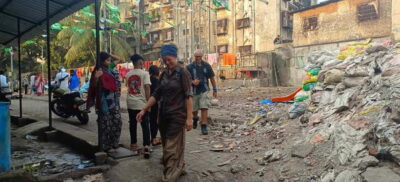
Dhobi Ghat Laundry and Dharavi Slum Tour with Local
Read our review →
Browse the lists this tour appears in