
Reviewed · SOUTH MUMBAI HERITAGE WALKS
Mumbai By Shantaram With Private Tour Guide
Mumbai is easiest to understand when you see its sharp contrasts in one day. This private tour moves from Mahalakshmi Dhobi Ghat and Dharavi to grand colonial buildings, busy Colaba, and the Gateway of India, giving you a city view that is broader than a standard monument walk.
I like the comfort of a private air-conditioned car, especially when Mumbai traffic and heat make long road journeys tiring. I also like the human focus: the guide explains how Dhobi Ghat works and helps you approach Dharavi as a lived-in neighborhood, not just a famous name from Shantaram.
The main drawback is the pace. Seven or eight hours covers a lot, but several stops are short, and Dharavi may feel uncomfortable for some people because the tour presents a side of Mumbai that is poor and crowded rather than polished.
In This Review
- Key points to know before booking
- Mumbai in one day, with the city’s contrasts up front
- Dhobi Ghat: Mumbai’s famous laundry district
- Dharavi: the most sensitive part of the day
- CST and the grand railway story
- The Bombay High Court and colonial Mumbai
- Colaba and the Mumbai of Shantaram
- Gateway of India and the Taj Mahal Palace
- What the $87 price includes
- The guide makes or breaks the experience
- Who should book this Mumbai tour?
- Should you book it?
- FAQ
- How long does the Mumbai Shantaram tour last?
- Is hotel pickup included?
- Is airport pickup included?
- Is this a private tour?
- What places are included?
- Are food and drinks included?
- Can I cancel for a full refund?
Key points to know before booking

- Dhobi Ghat is a working open-air laundry: See Mumbai’s famous washing district, where hereditary laundry workers handle clothes brought from across the city.
- Dharavi receives two hours: This is the longest stop and the clearest link to the rougher Mumbai described in Shantaram.
- You travel privately: Hotel pickup, an air-conditioned car, bottled water, fuel, parking, taxes, and the guide are included.
- The route mixes old Mumbai and modern city life: CST, the Bombay High Court, Colaba, the Gateway of India, and the Taj Mahal Palace balance the Dharavi visit.
- Guides named in guest feedback include Sanjay, Anisa, and Ali: The assigned guide may differ, but the experience depends heavily on the individual guide.
- The $87 price is easiest to justify for small groups: A private vehicle and personal guide offer more control than a shared sightseeing bus.
Mumbai in one day, with the city’s contrasts up front

The tour begins with pickup at your Mumbai hotel. You then settle into a private car with air conditioning and bottled water, a useful arrangement for a full day in a dense city where traffic can stretch short journeys.
Your guide is the key to making the day work. The route is not only a checklist of buildings. It connects Mumbai’s laundry workers, industrial communities, colonial institutions, railway history, film culture, and the neighborhoods linked with Shantaram. Guides named in the supplied feedback include Sanjay, Anisa, and Ali. Their reported strengths were friendly conversation, strong city knowledge, and careful organization, but you should treat those names as examples rather than a promise of a particular assignment.
The tour lasts about seven to eight hours. That is enough time to see many major points, but not enough for long museum visits, extended shopping, or a slow exploration of every district. I would choose it for a first look at Mumbai, especially if you have limited time and want a guide to handle the driving.
More South Mumbai heritage walks:
- Group Guided Walking Tour in Fort and Colaba
★ 5.0 · 1,073 reviews - Private Guided Walking Tour in Fort & Colaba
★ 5.0 · 895 reviews - Private Guided Open Jeep Tour in Fort & Colaba
★ 5.0 · 170 reviews
Dhobi Ghat: Mumbai’s famous laundry district
Mahalakshmi Dhobi Ghat is one of the day’s most distinctive stops. It is an open-air laundry occupying an entire block, with washing work carried out by hereditary laundry families. Clothes arrive here from around Mumbai, making the site a useful window into the city’s daily systems rather than a decorative attraction.
You will spend about 30 minutes here. The short visit is enough to see the scale of the operation and hear how the work is organized, though it will not give you a long, intimate look at every part of the district. Admission is not included, so check the final booking details for how the visit is handled.
This stop also requires good manners. Dhobi Ghat is a workplace and a residential area, not a performance arranged for tourists. Listen to your guide, follow instructions about where to stand, and ask before taking close photographs of people.
I like this stop because it gives you something you cannot understand from a passing car. Mumbai is often presented through its grand hotels and monuments, but Dhobi Ghat shows the physical work that keeps a huge city running.
Dharavi: the most sensitive part of the day

The tour allocates two hours to Dharavi, by far the longest stop. The description presents it as the part of Mumbai associated with the difficult side of Shantaram, where about one million people live within 215 hectares and rents are described as less than $4 per month.
Those figures help explain why Dharavi is often discussed as one of the world’s largest slum areas, but the numbers alone do not tell you what the visit will feel like. You are entering a place where people live and work. The area may be crowded, poor, noisy, and confronting. That is precisely why the guide matters.
I would book this portion only if you are willing to look beyond postcard Mumbai without treating hardship as a spectacle. The purpose should be to learn about residents and local life, not to collect dramatic photographs. A respectful guide can explain the area’s role in the city and help you understand why people live and work there.
The supplied information does not give a detailed walking route inside Dharavi, so you should not expect a guaranteed list of workshops, businesses, or viewpoints. What is clear is that the tour gives this district substantial time and places it at the center of the day’s Shantaram theme.
For some people, this will be the most meaningful part of the experience. For others, it may feel intrusive or emotionally heavy. If you prefer a gentler sightseeing day, choose a tour focused mainly on architecture, food, or film locations instead.
CST and the grand railway story
The route then turns toward Chhatrapati Shivaji Terminus, also called CST or the historic Chhatrapati Shivaji station. The building is one of Mumbai’s major architectural sights and a UNESCO World Heritage Site.
It took 10 years to build and is described as one of the city’s most beautiful buildings. The station also remains a major transport hub, so you see an active part of Mumbai rather than a preserved shell. That gives the stop energy, but it can also make photography and close inspection less relaxed.
You have about 30 minutes here. That is enough for an exterior look and an explanation from the guide. If you are passionate about architecture, you may want more time than this tour allows. Still, CST works well in the overall route because it shifts the day from residential hardship to public grandeur without pretending those two Mumbais are separate.
A few more Mumbai tours and experiences worth a look
- Private Mumbai Sightseeing Tour (Traveller’s Choice Award Winner)
★ 5.0 · 1,565 reviews - Elephanta Caves & Island Guided Private Tour
★ 5.0 · 1,327 reviews - Highlights of South Mumbai Guided Private Tour in AC Vehicle
★ 5.0 · 620 reviews - Private Mumbai Sightseeing Tour(Travellers Choice Award Winner)
★ 5.0 · 565 reviews
The Bombay High Court and colonial Mumbai
A 30-minute stop at the Bombay High Court adds another layer to the city’s architectural story. The building resembles a colonial palace, with towers, spires, and stone carving.
One small detail makes the stop memorable: a bas-relief shows a one-eyed monkey holding the scales of justice. Your guide can point out details like this, which are easy to miss when you simply drive past a grand facade.
The court is a working institution, so this is primarily an exterior sightseeing stop. Do not expect an interior tour unless your guide confirms otherwise. I find this kind of brief stop worthwhile when a guide explains what you are seeing, but less useful if you are hoping to spend a long time inside historic buildings.
Colaba and the Mumbai of Shantaram
Colaba is the part of the route most directly tied to Shantaram. The district sits beside the Arabian Sea and has long attracted visiting Europeans. Today it contains hotels, restaurants, and shops, giving the area a very different feel from Dharavi and Dhobi Ghat.
The tour allows about one hour here. That is enough to get a sense of the district and connect its streets with the book’s setting. It is not a dedicated literary walking tour, so do not expect a chapter-by-chapter exploration of locations from the novel.
Colaba is also a practical place to notice how Mumbai layers different eras in a small area. Colonial buildings, tourist landmarks, expensive hotels, and ordinary city traffic sit close together. Your guide can turn that visual mix into a clearer story about the city’s past and present.
I like this part of the tour because it gives the Shantaram theme a physical setting. The book is only one lens on Mumbai, but walking or driving through Colaba helps you see why this district has such a strong place in the city’s popular image.
Gateway of India and the Taj Mahal Palace
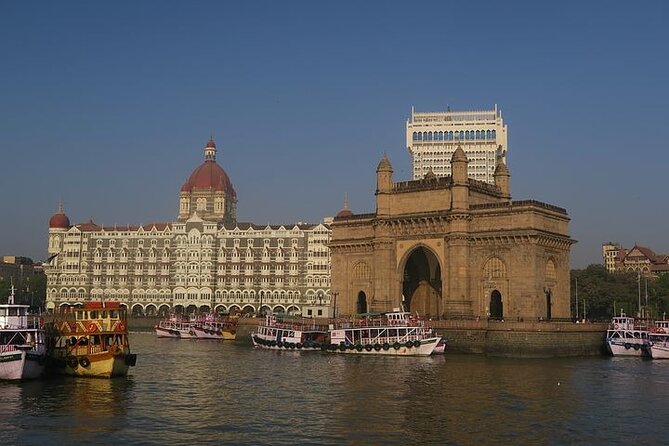
The Gateway of India is Mumbai’s best-known monument and the day’s main landmark stop. The triumphal arch faces the waterfront and is closely tied to the end of British rule. The tour notes that British forces left through the gateway after Indian independence, giving the monument a direct connection to the country’s modern political story.
You have around 30 minutes here. That should be enough to see the arch, take photographs, and hear the basic history. The waterfront can be busy, and the time may feel short if you want to linger.
Next door is the Taj Mahal Palace, one of Mumbai’s most famous and expensive hotels. The building is very close to the Gateway, so these two stops fit neatly together. The tour does not include a hotel stay or a specified interior visit. Think of it as an exterior landmark and a chance to see the contrast between a grand private hotel and the public waterfront beside it.
Together, the Gateway and the Taj provide a polished final image of Mumbai. After Dharavi and Dhobi Ghat, that contrast is intentional. The tour does not ask you to choose one version of the city. It puts several of them in the same day.
What the $87 price includes
The cost is $87 per person. For a private tour lasting seven to eight hours, that can be fair value if you are traveling with family or a small group and want a car, driver, and guide dedicated to your party.
The price includes:
- Hotel pickup and return
- A private air-conditioned car
- Bottled water
- Fuel, parking fees, and taxes
- The private guide’s fee
That list matters in Mumbai. You are not left arranging separate transport between distant parts of the city, and you avoid spending the day negotiating local rides. Private travel also makes it easier to ask questions, adjust the pace slightly, or spend more time discussing a stop that interests you.
Food and drinks are not included. The supplied cost is $20 per person for that extra item, and airport pickup or drop-off costs $40 per booking. Hotel pickup within Mumbai is included, so airport transfers should be arranged separately if you need them.
The value drops if you want a highly specialized tour. This is a broad city introduction, not a dedicated food, architecture, film, or literary tour. It covers many subjects, but the short stops limit how far the guide can take each one.
The guide makes or breaks the experience
The strongest personal details in the supplied feedback center on the guides. Sanjay is named for friendly conversation and a well-organized day. Anisa is described as explaining Mumbai’s people and history in an engaging way. Ali is associated with a comfortable new car and with organizing a day around religious sites for a group with limited time.
Those comments suggest a useful strength: the operator may be able to respond to your interests within a private format. Still, the published route here is fixed around Shantaram, Dharavi, Dhobi Ghat, and the main sights. If you have a special priority, such as temples, churches, or film locations, ask before booking rather than assuming it will be added.
A private guide also helps with context. Without explanation, a laundry district is just a busy block, a railway station is just a fine facade, and Dharavi can be reduced to a stereotype. The right guide connects each place to the people who use it.
Who should book this Mumbai tour?
I would recommend it for a first visit, a short stay, or a day between other plans. It suits you if you want major sights plus a candid look at working Mumbai, and if you prefer a private car to public transport.
It is also a good fit for families or small groups who value convenience. Group discounts are offered, though the exact reduction is not provided, so check the price for your party before paying.
You should think twice if you dislike visiting poor neighborhoods, need a slow pace, or want long interior visits. Dharavi is not a light sightseeing stop, and the whole day asks you to move between many districts.
Most participants can take part, and the experience is near public transportation, but the provided information does not give detailed mobility guidance for every stop. Ask the operator about walking requirements if that matters to you.
Free cancellation is available when you cancel at least 24 hours before the local start time. Cancellations within 24 hours are not refunded, and the tour may be changed or refunded if its minimum number of participants is not reached.
Should you book it?
Book this experience if you want Mumbai in broad, honest strokes: the laundry workers of Dhobi Ghat, the difficult realities of Dharavi, the railway grandeur of CST, the colonial court, literary Colaba, and the Gateway of India. The private car and guide make a packed day easier, and the $87 price is reasonable for a group that would otherwise pay separately for transport and guiding.
Skip it if your idea of a perfect day is a slow architectural walk or a polished film tour. The route is ambitious, the Dharavi stop can be confronting, and the short monument visits leave little time for lingering.
For a first look at Mumbai, I would choose this tour when understanding the city matters as much as photographing it.
FAQ
How long does the Mumbai Shantaram tour last?
The experience lasts approximately seven to eight hours, including hotel pickup, sightseeing, and the return to your hotel.
Is hotel pickup included?
Yes. Hotel pickup and drop-off within Mumbai are included in the tour price.
Is airport pickup included?
No. Airport pickup and drop-off cost $40 per booking.
Is this a private tour?
Yes. Only your group participates, and the tour uses a private air-conditioned car with a private guide.
What places are included?
The route includes Dhobi Ghat, Dharavi, Chhatrapati Shivaji Terminus, the Bombay High Court, Colaba, the Gateway of India, and the Taj Mahal Palace.
Are food and drinks included?
No. Food and drinks are listed as an additional cost of $20 per person. Bottled water in the car is included.
Can I cancel for a full refund?
Yes, if you cancel at least 24 hours before the experience start time. Cancellations or changes made within 24 hours are not refunded or accepted.
Just added around Mumbai
- Temples & Vineyards: Private Tour to Nashik from Mumbai★ 4.5 · 3 reviews
- Mumbai: Private City sightseeing and Dharavi Slum Tour★ 5.0 · 3 reviews
- Mumbai: Full Day City Sightseeing with Lunch, Car & Guide★ 4.3 · 3 reviews
- Elephanta Island Private Speedboat Tour from Mumbai – 6pax★ 5.0 · 3 reviews
- Mumbai Sightseeing Tour by Public Transport with family Lunch★ 5.0 · 3 reviews
- Mumbai by Dawn★ 4.5 · 3 reviews
- Mumbai: Elephanta Island and Elephanta Caves Guided Tour★ 4.4 · 3 reviews
- Mumbai Dharavi Slum Community Tour★ 5.0 · 3 reviews
South Mumbai Heritage Walks, compared.




Heritage Walk: Recommended by Gigi Hadid as a must-do in Mumbai
Read our review →
Mumbai 800 Year Worli Village: Talking Goddess, Old Fort & more
Read our review →

Mumbai Heritage Walk and Elephanta Caves Experience
Read our review →Browse the lists this tour appears in